BDC vs Internet Sales: Who Owns the Lead? (And Why Most Stores Get It Wrong)
BDC or Internet Sales — who should own dealership leads? Here’s where most stores get it wrong, plus a framework for higher appointments and revenue.
Every dealership talks about “owning the lead,” but very few define what that actually means. The result is a constant tug-of-war between BDC and Internet Sales, leading to missed follow-ups, weak appointments, inconsistent communication, and managers stuck refereeing instead of leading. Most stores chalk these problems up to talent, effort, or personality conflicts. But the truth is simpler and far more fixable.
Dealership lead management isn’t a people problem. It’s a structural problem.
When ownership is unclear and handoffs are ad hoc, even talented teams underperform. The CRM becomes a suggestion instead of a system. Customers receive different messages depending on who answers the phone. While at the store, customers aren’t getting messages at all because everyone thinks someone else has got it handled.
If this sounds familiar, you’re in luck. We’ve unpacked a clear framework used by top-performing dealerships to eliminate fingerpointing, raise appointment quality, tighten handoffs, and increase both show rate and gross. It will help you diagnose where your current model is breaking down and show you how to rebuild ownership stage by stage. If you adopt what is presented here, every lead moves forward, and every team knows exactly what to do next.
In these chapters, discover how to fix the root cause and not just the symptoms:
1) The Real Tension Inside Most Dealerships
The breakdown usually looks something like:
The internet leads come in → BDC says sales aren’t following up → Sales says BDC sets weak appointments → Managers blame both → The customer gets inconsistent communication.
The better news is that people aren’t the problem; it’s a structural issue. Talented teams stumble when ownership is fuzzy, hand-offs aren’t part of an operational strategy, and the CRM doesn’t enforce a workflow.
If you’ve ever heard “I thought they had it,” you don’t have a performance gap; you have a process gap.
2) Signs Your Current Model is Broken
If you relate to more than one of these, your lead management model needs a reset:

- BDC blames Sales for noshows, and Sales blames BDC for weak appointments.
- Nobody can explain who owns follow up after a missed appointment.
- Sales cherry picks leads and ignores the rest.
- CRM shows duplicate outreach or zero outreach.
- Managers get different answers depending on who they ask.
- Lead response times vary wildly across reps.
If your team can’t easily explain the handoff process, then the handoff likely doesn’t exist.
3) What a BDC Is Designed to Do (At Its Best)
BDC best practices should include:
- Respond fast (within minutes, not hours).
- Qualify intent (timeline, budget signals, need vs. curiosity).
- Book appointments with a clear date/time, set expectations, and provide a salesperson’s name.
- Nurture long cycle prospects (e.g., 30–180+ days).
- Maintain a follow-up cadence that never goes dark.
A BDC is not designed to:
- Desk deals.
- Negotiate pricing.
- Build gross.
- Structure trades.
A high functioning BDC is a speed to lead and pipeline engine.
4) What Internet Sales is Designed to Do (At Its Best)
Internet Sales should:
- Personalize communication with high-intent buyers (offer vehicle-specific answers, videos, and value props).
- Manage inventory-specific conversations (provide answers regarding VIN alternatives, incoming units, and add-ons).
- Convert digitally when needed (have access to digital retailing tools and remote deposits).
- Own complex deal conversations (be versed in trade nuances, credit path, payment/term alignment).
Internet Sales is not designed to:
- Bulk dial cold leads.
- Manage large nurture pipelines.
- Operate like a call center.
A strong Internet Sales function is a conversion specialist, not a volume call machine.
5. Days 61–90: Build the System
By day 60, trust is building and early wins are visible. Now, systematize how the store operates so performance doesn’t depend on your presence.

Formalize the Process
- Document the lead-to-delivery process for every department.
- Define who owns the customer at each stage and provide clear entry/exit criteria.
- Build dealership CRM workflows that automate tasks and escalations automatically — not manually.
Build Your Dashboard
Pick 5–7 dealership metrics to review with your managers every Monday. Review the same numbers and the same cadence:
If your team can’t easily explain the handoff process, then the handoff likely doesn’t exist.
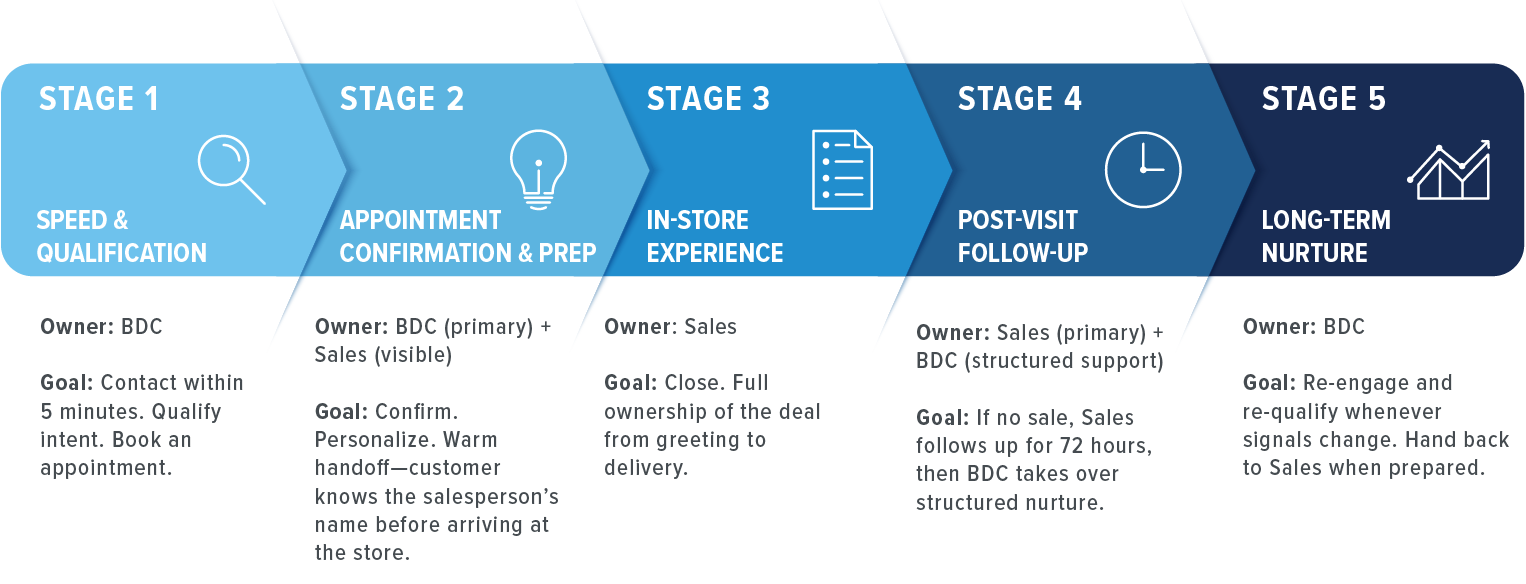
6) The Stage Based Ownership Framework
Ownership should shift based on expertise and stage, not politics. Here’s the model top tier stores use to raise response speed, show rates, and close:
Stage 1: Speed & Qualification
- Owner: BDC
- Goal: Contact within 5 minutes. Qualify intent. Book an appointment.
Stage 2: Appointment
Confirmation & Prep
- Owner: BDC (primary) + Sales (visible)
- Goal: Confirm. Personalize. Warm handoff—customer knows the salesperson’s name before arriving at the store.
Stage 3: In-Store Experience
- Owner: Sales
- Goal: Close. Full ownership of the deal from greeting to delivery.
Stage 4: Post Visit Follow-Up
- Owner: Sales (primary) + BDC (structured support)
- Goal: If no sale, Sales follows up for 72 hours, then BDC takes over structured nurture.
Stage 5: Long Term Nurture
- Owner: BDC
- Goal: Re engage. Re qualify when signals change. Hand back to Sales when ready.
Why These Stages Work:
- Clear lanes reduce friction.
- Specialization boosts quality (speed & pipeline with BDC; deal making with Sales).
- Handoffs are defined, visible, and evident in the CRM usage.
7) Which Model Fits Your Store?
Pick your staffing model by lead volume, then apply the same stage based framework:
Under 300 leads/month:
- Model: Dedicated Internet Salespeople (cradle to grave) with strict follow up rules.
- Why: A full BDC rarely pencils at this volume. One person can own all stages if speed and cadence are enforced in the CRM.
300–700 leads/month:
- Model: Hybrid–BDC handles speed, qualification, and nurture. Sales owns the appointment forward.
- Why: Volume justifies specialization, but not a massive call center.
700+ leads/month:
- Model: Full BDC required. Volume demands clarity on roles and process automation.
- Why: Without specialization, response time and follow up quality collapse.
As leads increase, the framework should scale, and the staffing model should be modified.
8) Compensation: The Hidden Landmine
This is where most attempts to “fix the process” die. If your compensation plan fights your process, the compensation plan wins every time. Structure your pay to reward the right behavior at the right stage.
What misalignment looks like:
- BDC is paid per appointment set → they set soft appointments to hit a number → show rates drop.
- Sales is paid only on closed deals → they ignore appointments they didn’t source → handoffs break.
- Both departments optimize for their plan, not the customer.
What alignment looks like:
- BDC: Paid on Appointments that Show (ATS).
- Sales: Small bonus tied to BDC (based on sourced close rate, not just unit count).
- Shared upside: If the handoff works, both win.
Structure your comp to match the framework.
9) How CRM Structure Solves the Problem
The right dealership CRM doesn’t decide who owns the lead; it enforces the process you design. Configure it to make the path of least resistance the right path for everyone.

Must haves:
- Clear task assignments by stage: Stage 1 tasks auto assign to BDC; Stage 3 tasks auto assign to the named salesperson.
- Defined ownership transitions (system driven): Moving from Stage 2 to Stage 3 automatically reassigns the primary owner. No manual “pretty please” handoffs.
- Automated escalation: If Stage 1 isn’t touched in 5 minutes, alert a manager and reassign to the next available rep. If Stage 4 isn’t touched within SLA, push back to BDC.
- Manager visibility by stage: Dashboards for speed to lead, ATS, show, close, and post visit follow up completion.
Mirror the five stages from the framework as statuses in your CRM.
10) The Diagnostic Question
Can every person at your store explain—in one sentence—who owns each stage of the customer journey? If the answer changes depending on who you ask, you don’t have a lead management process; you have a lead management opinion. If your team is struggling with this, it might be an issue with information transfer. Read about why meetings fail to get pointers for how to effectively relay key operational details, then implement this weekly inspection practice:
Manager Scorecard (What to Inspect Weekly):
Stage 1 (Speed to Lead): % contacted < 5 minutes.
Stage 2 (ATS): Appointments that show / Appointments set.
Stage 3 (Show to Close): Closed deals / Shows.
Stage 4 (72 Hour Compliance): % of no sale visits with Sales led follow up completed.
Stage 5 (Recycle Health): % of nurtured leads re qualified and re presented to Sales.
If any stage underperforms, fix the owner behavior and the handoff—not just the script.
The BDC vs. Internet Sales debate exists only when ownership is murky, and the CRM isn’t enforcing the stages. When next-steps are clear and pay plans reward the right behaviors, arguments fade and appointments, shows, and revenue rise. Use this Stage Based Ownership Framework to make dealership lead management explicit, handoffs visible, accountability nonnegotiable, and long-term dealership performance mastered.