
The Dealership Org Chart: Who Does What and Who Reports to Whom
A clear breakdown of the dealership org chart for every role from the Dealer Principal down to BDC and Service.
Every Dealership Runs on the Same Basic Org Chart
Whether you’re a new employee trying to understand dealership structure, a manager building a career path, or a dealer evaluating staffing, every dealership follows a surprisingly similar dealership org chart.
According to NADA dealership data, the average U.S. franchised dealership employs approximately 65 people. A business of that size requires clear leadership, defined responsibilities, and a chain of command that keeps every department aligned.
The challenge is that most information on dealership roles focuses only on individual job descriptions. One description will explain what a Sales Manager does, another will cover Service Advisors, and the third will discuss Finance Managers.
This guide will bring everything together into one complete map.
We’ll break down every major dealership position, what each role owns, who they report to, and where they fit within the larger organization. While structures vary slightly by dealership size, brand, and ownership group, the chart below represents the standard organizational model used by most franchised dealerships in the United States.
The Dealership Org Chart
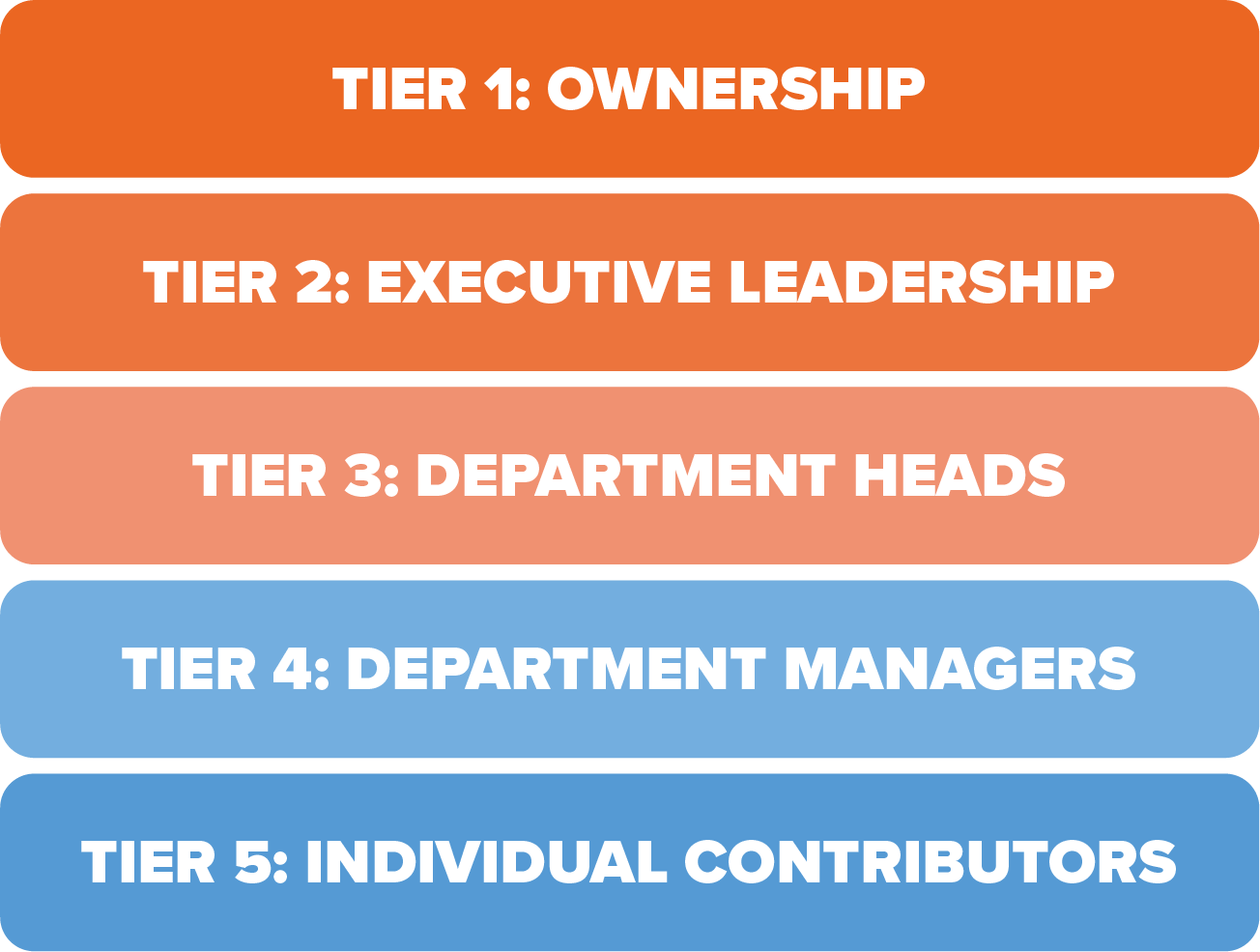
The exact titles may vary, but the reporting structure remains consistent across the industry.
The typical dealership structure follows these five tiers:
Tier 1: Ownership
- Dealer Principal / Owner
Tier 2: Executive Leadership
- General Manager (GM)
Tier 3: Department Heads
- General Sales Manager (GSM)
- Fixed Operations Director
- Finance & Insurance (F&I) Manager
- Marketing Director
- Office Manager / Controller
Tier 4: Department Managers
- Sales Managers
- Service Managers
- Parts Managers
- BDC Managers
- Internet Sales Managers
Tier 5: Individual Contributors
- Sales Consultants
- Service Advisors
- Technicians
- Parts Counter Personnel
- BDC Representatives
- Administrative Staff
Who Reports to Whom: The Chain of Command

At most dealerships, the reporting structure is straightforward.
- The Dealer Principal normally owns the store
- The General Manager runs the store
- Every department head reports to the General Manager.
From there, department managers oversee day-to-day operations, and individual contributors execute the work that generates revenue and serves customers.
The chain typically looks like this:
| Role | Reports To | Owns |
| Dealer Principal | Ownership Group/Self | Entire dealership |
| General Manager | Dealer Principal | Daily dealership operations |
| Department Heads | General Manager | Department performance |
| Managers | Department Heads | Team execution |
| Individual Contributors | Managers | Customer-facing activities |
This structure also mirrors the typical dealership career ladder. Many dealership professionals begin in customer-facing roles before moving into management and eventually executive leadership. For a deeper look at advancement opportunities, see our car sales career path guide.
The Front End (Variable Operations): Sales & F&I
Variable Operations encompasses all aspects of vehicle sales and financing. These departments drive new- and used-vehicle revenue and often represent the most visible parts of the dealership. There are a few titles that sound similar but carry different roles. Let’s break them down.
What Does a General Manager Do?
The General Manager oversees all dealership operations and reports directly to the Dealer Principal or Owner.
Dealership GM skills include responsibilities for profitability, staffing, departmental performance, customer satisfaction, and overall dealership strategy.
Every major department ultimately reports through the GM, making this role the operational leader of the dealership.
What Does a General Sales Manager (GSM) Do?
The General Sales Manager leads the entire sales department and reports to the General Manager.
The GSM oversees both new and used-vehicle sales operations, manages Sales Managers, sets sales goals, and ensures the dealership meets revenue targets.
In many dealerships, the GSM acts as the bridge between executive leadership and the sales floor.
What Does a Sales Manager or Desk Manager Do?
Automotive Sales Manager skills include overseeing daily sales activity. They report to the GSM.
They work directly with sales consultants, structure deals, approve pricing, manage inventory placement, and coach salespeople throughout the sales process.
One of the most common questions about dealership organization is the difference between a GSM and a Sales Manager.
The answer is simple:
- The GSM oversees the entire sales department.
- Sales Managers oversee individual teams and daily sales operations.
Think of the GSM as the department leader and the Sales Manager as the frontline manager.
What Does a Sales Consultant Do?
Sales Consultants sell vehicles and report to a Sales Manager.
They handle customer interactions, vehicle demonstrations, test drives, follow-up communication, and deal progression from initial contact through delivery.
Sales Consultants are often the largest employee group within the dealership and serve as the primary customer-facing representatives of the sales department.
What Does an F&I Manager Do?
The Finance & Insurance Manager arranges vehicle financing, presents protection products, and typically reports to the General Manager or GSM.
After a vehicle purchase agreement is reached, customers meet with the F&I manager to complete financing paperwork, secure lender approvals, and review products such as service contracts, GAP coverage, and maintenance plans.
Reporting structures for F&I vary more than most dealership roles. In some stores, F&I reports directly to the GM. In others, the role reports through the GSM. Some dealer principals maintain direct oversight because of the department’s impact on profitability and compliance.
The BDC / Internet Department

As dealerships shifted toward digital retailing, Business Development Centers (BDCs) became a critical part of dealership operations.
The BDC serves as the bridge between marketing and sales, handling incoming leads before customers arrive at the dealership.
What Does a BDC Manager Do?
The BDC Manager oversees lead management, appointment setting, and customer communication activities and reports to the General Manager or GSM.
The role focuses on improving lead response times, appointment rates, show rates, and overall customer engagement.
Successful BDC managers ensure that no leads fall through the cracks and that sales teams receive qualified appointments.
What Does a BDC Representative Do?
BDC Representatives communicate with prospects and report to the BDC Manager.
Their responsibilities include:
- Answering inbound calls
- Responding to internet leads
- Scheduling appointments
- Following up with prospects
- Re-engaging inactive customers
Rather than selling vehicles directly, BDC Representatives focus on moving customers to the next step in the buying journey.
For more information, see our guide on BDC Manager best practices.
What Does an Internet Sales Manager Do?
The Internet Sales Manager oversees online lead generation and digital sales processes and reports to the GSM or General Manager.
Depending on dealership size, the ISM may manage Internet Sales Consultants, oversee digital lead handling, and coordinate closely with marketing teams.
In some dealerships, the Internet Sales Manager and BDC Manager are separate positions. In others, one person performs both functions.
Learn more about successful Internet Sales Manager habits and responsibilities.
The Back End (Fixed Operations): Service & Parts
While sales often receive the most attention, fixed operations are the financial engine of many dealerships.

According to NADA dealership data, fixed operations generate approximately 49% of dealership gross profit. That makes service and parts not just support functions, but major profit centers.
As a result, fixed operations typically have their own leadership structure.
What Does a Fixed Operations Director Do?
The Fixed Operations Director oversees service, parts, and customer retention activities and reports to the General Manager.
This role is responsible for profitability, operational efficiency, customer satisfaction, technician productivity, and long-term service retention.
Larger dealerships and dealer groups are more likely to employ dedicated Fixed Operations Directors.
What Does a Service Manager Do?
The Service Manager leads the service department and reports to the Fixed Operations Director or General Manager.
Responsibilities include:
- Managing Service Advisors
- Supervising Technicians
- Monitoring repair order volume
- Improving shop productivity
- Maintaining customer satisfaction scores
The Service Manager serves as the operational leader of the service department.
What Does a Service Advisor Do?
Service Advisors act as the primary customer contact within the service department and report to the Service Manager.
They greet customers, recommend maintenance and repairs, prepare repair orders, communicate repair status, and ensure customers understand service recommendations.
Many dealerships consider Service Advisors among the most influential customer-facing employees because they directly impact retention and repeat business.
What Does a Technician Do?
Technicians diagnose and repair vehicles and report to the Service Manager through shop foremen or team leads when applicable.
Technicians perform maintenance, warranty repairs, diagnostics, inspections, and complex mechanical work.
Their productivity directly affects service department profitability and customer satisfaction.
What Does a Parts Manager Do?
The Parts Manager oversees inventory, purchasing, and parts operations and reports to the Fixed Operations Director or General Manager.
The role ensures technicians and Service Advisors have access to the parts required to complete repairs efficiently.
Parts Managers also oversee wholesale parts sales and inventory controls.
Marketing & Administration
Although these departments are typically smaller than sales and service, they play a critical role in dealership performance.
What Does a Marketing Director or Marketing Manager Do?
The Marketing Director manages advertising, lead generation, digital channels, analytics, and reporting and reports to the General Manager.
Responsibilities often include:
- Advertising strategy
- Website performance
- Paid search campaigns
- Social media
- CRM marketing
- Lead attribution
- Vendor management
In larger dealer groups, marketing may report to a centralized corporate team rather than the individual dealership GM.
What Does an Office Manager or Controller Do?
The Controller or Office Manager oversees accounting, payroll, financial reporting, and compliance and reports to the General Manager or Dealer Principal.
This department ensures financial accuracy, manages dealership accounting processes, and helps maintain regulatory compliance.
While often less visible than sales or service, the office team is essential to dealership operations.
How the Chart Changes: Single Rooftop vs. Dealer Group
Not every dealership follows the same structure. The biggest differences emerge when comparing independent rooftops to larger dealer groups.
| Single Rooftop Dealership | Dealer Group |
| Dealer Principal directly oversees GM | Regional leadership added above GM |
| Marketing is often local | Marketing is frequently centralized |
| BDC may be dealership-specific | BDC may be centralized across stores |
| Fewer management layers | More executive layers |
| GM wears multiple hats | GM focuses on store execution |
| Faster decision-making | More standardized processes |
In a single-store dealership, the GM often serves as the primary decision-maker for nearly every department.
In larger dealer groups, additional leadership positions such as Regional Vice Presidents, Platform Presidents, and Corporate Directors may sit between dealership leadership and ownership.
As dealer groups grow, support functions like marketing, BDC, HR, and accounting are increasingly centralized across multiple locations.
Learn more about how dealership tools can be differentiated for enterprise-level dealer groups.
Frequently Asked Questions:
What is a dealership org chart?
A dealership org chart is a visual representation of the reporting structure within a car dealership. It shows who reports to whom and how departments such as sales, finance, service, parts, marketing, and administration are organized.
Who is in the highest position at a car dealership?
The Dealer Principal or Owner is typically the highest-ranking position. This individual owns the dealership and ultimately oversees all operations.
What is the difference between a GSM and a Sales Manager?
A General Sales Manager (GSM) oversees the entire sales department, including multiple Sales Managers and overall sales performance. A Sales Manager focuses on day-to-day sales activities, deal management, and coaching sales consultants.
How many employees does the average car dealership have?
According to NADA dealership data, the average franchised dealership employs approximately 65 people across sales, service, parts, finance, marketing, administration, and leadership roles.
Take This Knowledge to Define Your Dealership Career
Every dealership may have its own culture, processes, and job titles, but the organizational structure remains consistent. Ownership sets direction; the general manager runs the business; department heads drive performance; managers execute strategy; and frontline employees serve customers.
Understanding the hierarchy helps employees identify career paths, enables managers to build accountability, and gives dealership leaders a clear view of how every department contributes to overall profitability.
Whether you’re entering the automotive industry, hiring new talent, or restructuring your organization, this dealership org chart provides the foundation for operational success.
But this can’t be done at the expected level of efficiency without dealership performance software that keeps everyone in line and moving forward.
AutoAlert CXM can boost performance across all departments and at every position – making it even more motivating and lucrative for team members aspiring to climb the dealership’s employee hierarchy.

Ready to Turn Your Data into Action Across the Entire Dealership?
See how AutoAlert CXM helps dealerships simplify operations, identify the right opportunities faster, and source higher-quality inventory from customers they already know.