
The Dealership Marketing Director’s Playbook:Strategy, Tools, and KPIs
The Hardest Marketing Job in Retail
U.S. car dealers spend an average of $529K per year on advertising, with 73% now digital (Statista; Demand Local 2025). Yet 92% of vehicle sales remain untraceable in traditional dealership CRM systems (Cox Automotive).
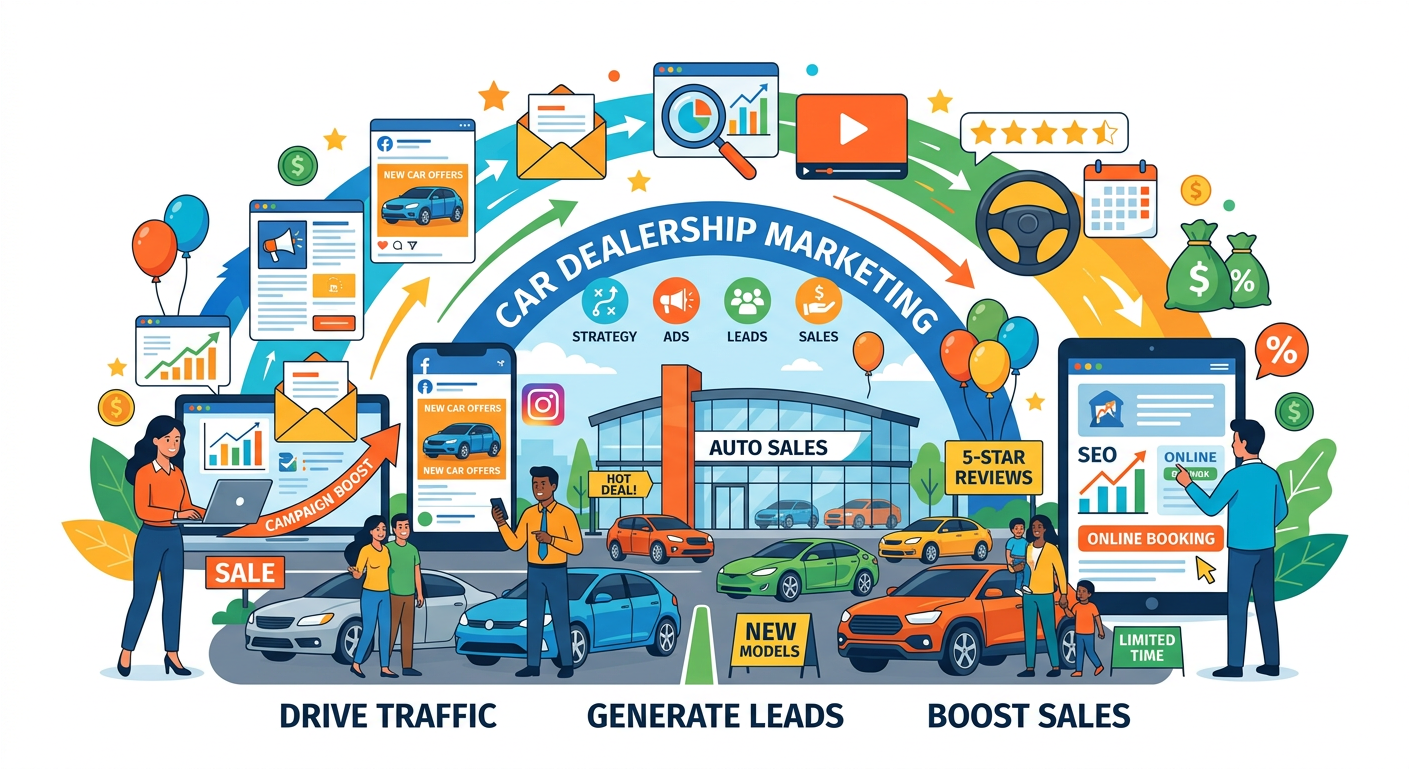
That’s the paradox: the dealership marketing director is responsible for results most stores can’t fully measure.
As consumer behavior becomes more fragmented across search, social, AI tools, marketplaces, and service interactions, the role requires balancing data analysis with strategic decision-making. Marketing directors are expected to improve profitability, customer retention, and operational efficiency despite incomplete attribution models and rapidly changing digital platforms.
This is the playbook for what today’s marketing director does, what they own, how they’re measured, and what “good” looks like in 2026.
What a Dealership Marketing Director Actually Does
A dealership marketing director owns the budget, channels, data, brand, team, and reporting that drive demand and retention across the store. At a single rooftop, they typically report to the GM or dealer principal. At the group level, they report to a VP or CMO.
What they are not:
- Not a salesperson
- Not a BDC manager
- Not a vendor account coordinator

The role has evolved significantly as dealerships rely more heavily on digital operations, customer data, and measurable performance. Today’s marketing director must align departments, manage technology ecosystems, oversee agency relationships, and translate complex reporting into actionable business decisions that improve profitability and long-term customer retention.
They operate growth systems that are responsible for turning marketing spend into measurable revenue across both sales and service.
The 2026 Channel Mix
73% of dealership ad spend is digital, with the remainder in traditional channels like TV, radio, and print.
The average annual spend per rooftop (Demand Local, 2025):
- Third-party listings: $109,487
- Paid search: $105,256
- Social media: $60,030
The most important strategic shift: Owned vs. rented channels.
- Owned: website, content, CRM database → compound over time
- Rented: paid ads, third-party marketplaces → cost stays constant
As competition and advertising costs continue to rise, marketing directors are under pressure to build sustainable customer acquisition systems. Investments in SEO, first-party data, email retention, and service marketing create long-term value. At the same time, overreliance on paid marketplaces can leave dealerships vulnerable to rising costs and reduced customer ownership.
Strong marketing directors shift budget toward owned channels every year to reduce long-term cost per sale. For tactical execution, see: dealership marketing strategies.
Upper Funnel vs. Lower Funnel
A dealership marketing director doesn’t just own lead generation; they own the entire customer journey.
- Upper funnel (awareness): search, SEO, video, social, display, third-party listings
- Lower funnel (activation): CRM campaigns, equity mining, retention, follow-up
This matters because car buyers spend an average of 14 hours and 19 minutes online and take 1–6 months to decide (Demand Local, 2025). If marketing only focuses on leads, it misses most of the journey.
The strongest marketing directors build dealership marketing strategies that nurture shoppers long before they submit a form and continue engagement after the sale. Their focus extends beyond traffic generation to customer retention, service loyalty, repeat purchases, and creating personalized experiences that keep the dealership top-of-mind throughout the ownership lifecycle.
Lower-funnel execution relies heavily on the automotive CRM, where the highest-converting opportunities already exist.
The KPIs Worth Reporting
The most effective marketing directors report business outcomes and not just marketing activity.

Core dealership KPIs:
- Cost per lead (CPL): ~$38.86 average for search
- Cost per vehicle retailed: typically, $250–$700 per unit
- Show-to-sale rate: ~New: 41%; ~Used: 40% (Demand Local)
However, the biggest miss in most stores is service marketing metrics:
- Service drives ~49% of gross profit on only ~12% of revenue (NADA)
High-performing directors also monitor retention rates, reactivation campaigns, appointment conversion, customer lifetime value, and service-to-sales opportunities. These metrics provide a more complete view of dealership profitability and help leadership understand how marketing influences fixed ops revenue, customer loyalty, and future vehicle sales beyond immediate lead generation.
Marketing directors who report only sales KPIs are ignoring the dealership’s most profitable side. For a deeper breakdown, see: dealership KPIs.
Why Attribution Is the Hardest Part
92% of vehicle sales are untraceable in traditional CRM systems (Cox Automotive).
Why? The average buyer journey includes 62 touchpoints over ~95 days. CRMs only capture the touchpoints that become leads.
New complexity in 2026: 19% of all buyers (25% of new buyers) use AI tools like ChatGPT, Copilot, and Google AI Overviews during shopping (Cox Automotive 2025 Car Buyer Journey Study). These interactions are largely invisible in dealership reporting.
This means marketing directors must make decisions with incomplete attribution data while still proving ROI to ownership and leadership teams. The challenge is no longer just generating leads—it’s identifying influence across fragmented channels, anonymous browsing behavior, and AI-assisted research paths that rarely appear inside traditional reporting dashboards.
What high-performing marketing directors do differently:
- Move from last-click to multi-touch attribution
- Implement call tracking and conversation tracking
- Connect CRM, website, and ad platforms into a unified reporting layer
The Marketing Director’s Tech Stack
A dealership marketing director manages six core technology layers:
- Website & SEO platform – foundation of owned traffic
- CRM / CXM system – customer data and lifecycle marketing
- Ad platforms – Google, Meta, third-party marketplaces
- Email & direct mail tools – retention and reactivation
- Reputation management tools – reviews and ratings
- Attribution & reporting tools – performance visibility

Modern marketing directors are also responsible for ensuring clean data flow between systems, reducing duplicated efforts, and improving reporting accuracy. As AI-powered tools become more common, they must evaluate integrations, automate workflows, and ensure every platform contributes to measurable dealership growth rather than creating disconnected marketing silos.
Their job is not to master each tool individually, but to make them work together as a system.
Pay and Career Path
A dealership marketing director’s compensation reflects their impact on revenue.
- Single rooftop / small group: $83K–$118K average; top performers $125K–$198K (Glassdoor, ZipRecruiter 2025)
- Mid-size group directors: $129K–$141K (Indeed, Comparably)
- Large public groups: $210K–$315K total compensation (Salary.com)
Bonus structures are increasingly tied to measurable KPIs such as lead quality, service retention, cost per sale, digital engagement, and total dealership revenue growth. Directors who successfully integrate AI, first-party data strategies, and omnichannel marketing often command higher compensation and accelerated advancement opportunities within dealer groups.
Dealership Marketing Director’s career progression:
Marketing Coordinator → Manager → Director → Group Director / VP
Top performers often transition into broader leadership roles, including GM positions (see: dealership GM skills).
What’s Changing in 2026

AI is reshaping the top of the funnel.
– Google AI Overviews now appear in 30–40% of searches, and ChatGPT serves ~200M weekly users.
Affordability is driving messaging.
– 62% of buyers say vehicles are becoming too expensive (Cox Automotive, 2025).
– Messaging is shifting toward payments, leases, and CPO.
Service marketing produces revenue.
– As new vehicle margins tighten, fixed ops becomes the stability engine.
– Service appointments turn into sales by making every visit count before, during, and after their appointment.
Reputation as a commodity.
– Dealership customer retention is achieved through consistent ownership experience, speed of follow-up, and personalization by re-engaging existing owners at optimal trade cycles.
– Service and purchase interactions directly impact dealership online reviews and influence CSI scores.
The dealership marketing director in 2026 isn’t just running ads; they’re orchestrating a full-funnel growth engine, balancing brand, data, and performance in a system where visibility is imperfect, but accountability is absolute. They align sales, service, CRM, and inventory strategies while managing AI tools, addressing attribution gaps, improving customer retention, and adapting to shifting buyer behavior across every digital touchpoint. Their role is equal parts strategist, analyst, operator, and revenue driver for the entire dealership.
The right tools, like AutoAlert, give the dealership marketing director the wheels to do their job more efficiently, effectively, and with greater impact.
FAQ: Dealership Marketing Director
Q: What does a dealership marketing director do?
They own the dealership’s marketing strategy, budget, channels, data, and reporting to drive both sales and service revenue.
Q: How much does a dealership marketing director make?
Most earn between $83K and $141K, with top performers and large-group leaders exceeding $200K+ in total compensation.
Q: What is the average dealership marketing budget?
Roughly $529K annually per store, with about 73% allocated to digital channels.
Q: What channels do car dealers spend the most on?
Third-party listings, paid search, and social media account for the largest share of digital spend.
Q: Is a dealership marketing director the same as an automotive marketing manager?
Not exactly. Managers typically execute campaigns, while directors own the strategy, budget, and performance across the entire dealership.
In practice, the director role also includes cross-department alignment, vendor management, CRM oversight, attribution interpretation, and continuous optimization of both acquisition and retention efforts to ensure marketing investments translate into measurable dealership profitability.
Start your journey to dealership marketing success today.